How Directional Drilling Works in Piedmont Triad Ground
The weathering profile: clay, saprolite, and the lottery beneath
Triad ground is the piedmont's layer sequence read top-down: red clay at the surface, saprolite beneath — granite and gneiss rotted in place to a dense, drillable soil that remembers being rock — and the fresh crystalline basement below, arriving at depths that vary parcel to parcel without pattern enough to guess. The estimating consequence is the lottery: two identical-looking crossings a mile apart can differ by a full rock class, so honest Triad quoting names its weathering assumption, prices the fresh-rock contingency in the open, and treats a soil boring as cheap insurance on anything deep, long, or large. Rockingham's Dan River country adds the northern variation — sedimentary ground with softer manners, named per reach where alignments cross into it.
The megasite era: utilities ahead of buildings
The Triad's industrial reinvention changed the utility trade's tempo: the battery campus, the aviation cluster, and the supplier-and-logistics ring they anchor bring programs where power, water, and fiber arrive ahead of the buildings they'll serve, on milestone calendars coordinated through project machinery rather than ordinary counters. For HDD it's the home game — crossings without cutting new pavement, long runs down live corridors, campus geometry placed to the drawing — and the discipline is scheduling: loaded permit queues, phased corridor construction, and milestone dates that don't move for weather. Our quotes carry the era's tempo as the site condition it is.
The sequence, Triad edition
The bones are standard — locates plus private designating, potholes on every claimed utility, pilot on profile, ream to about one and a half times the product, pull, restore. Triad bends: the weathering assumption stated and tooled for, watershed and buffer rules carried where the lake chains and streams apply them, ice-storm season respected in staging, megasite milestones treated as fixed points, and restoration that honors everything from Fisher Park's old streets to Randolph's farm-edge ROW.
Who owns what you're crossing
The cities run their own ROW processes inside their limits; NCDOT holds the road map beyond them and permits the interstates and the loop. The watershed lakes carry the cities' source-water controls; the buffered streams carry the state's riparian rules; the Dan adds its two-state watershed conversation north; greenways and parks steward the urban banks; railroads permit their corridors; and the megasite projects run their own coordination machinery at corridor tempo. The quote names every owner on your alignment — here, the first questions are whose pavement and whose watershed.
Straight answers
Will you hit rock on my bore?
The honest Triad answer is: name the assumption, price the contingency, and let a boring settle it where the stakes justify. Most utility-depth work rides clay and saprolite comfortably; the fresh-rock lottery pays out somewhere on every long route; and the quote that admits both up front is the one that survives to the invoice.
How deep do bores run under Triad streets?
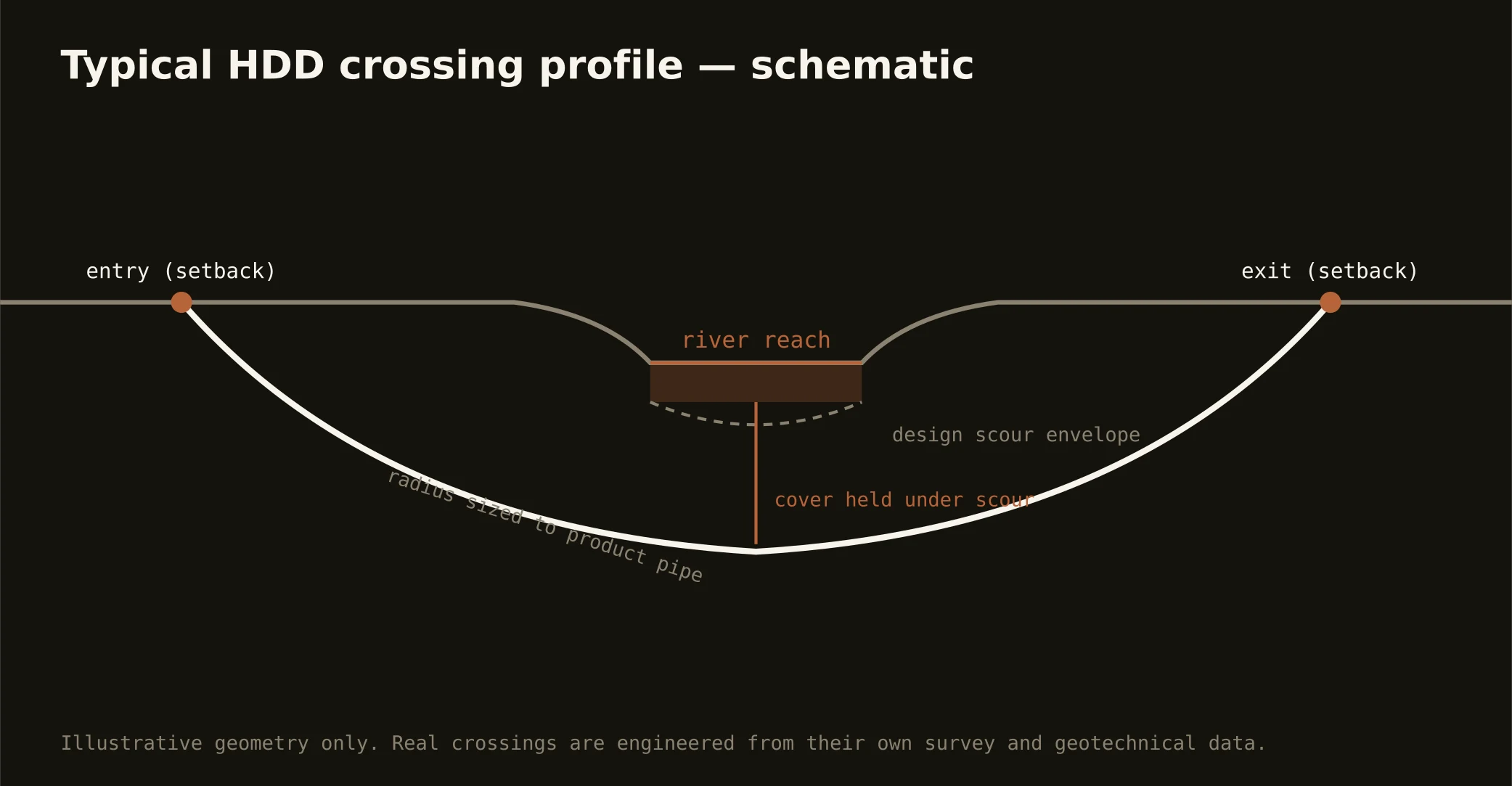
Cover follows the owning authority's standard — a city's or NCDOT's — and sits below everything potholed on the alignment; river and lake-adjacent crossings run to the buffer and source-water criteria. Depth can change the geology mid-profile here, so the bore plan states both your number and your expected ground at it.
Do the watershed rules really reach ordinary street work?
More often than the map suggests: Greensboro's lake chain sits inside its own county, so water-supply-watershed districts and their critical-area rules cover real acreage of ordinary-looking suburbia. The controls are erosion, containment, and review rigor rather than prohibition — and our quotes name the watershed whenever an alignment sits in one, because that's where schedule honesty starts.
Ready to put a number on a real crossing? Send the scope — a person prices it.